Why Life Cycle Thinking is Essential for Sports Organisations
Across the sports industry, organisations are under growing pressure from governing bodies, sponsors, and fans to demonstrate credible environmental action. Reducing environmental impact is now core to strategic decision-making, commercial partnerships, and long-term resilience.
While many sports organisations have taken steps to measure their carbon footprint, traditional reporting often focuses on Scope 1 and Scope 2 emissions, overlooking the much larger indirect impacts within Scope 3. These upstream and downstream emissions make up the majority of a sports organisation’s footprint, from travel and transportation to supply chains and merchandise. Aside from carbon footprint, other environmental and social impacts also need to be accounted for, such as water use, land use, resource depletion, and particulate matter emissions.
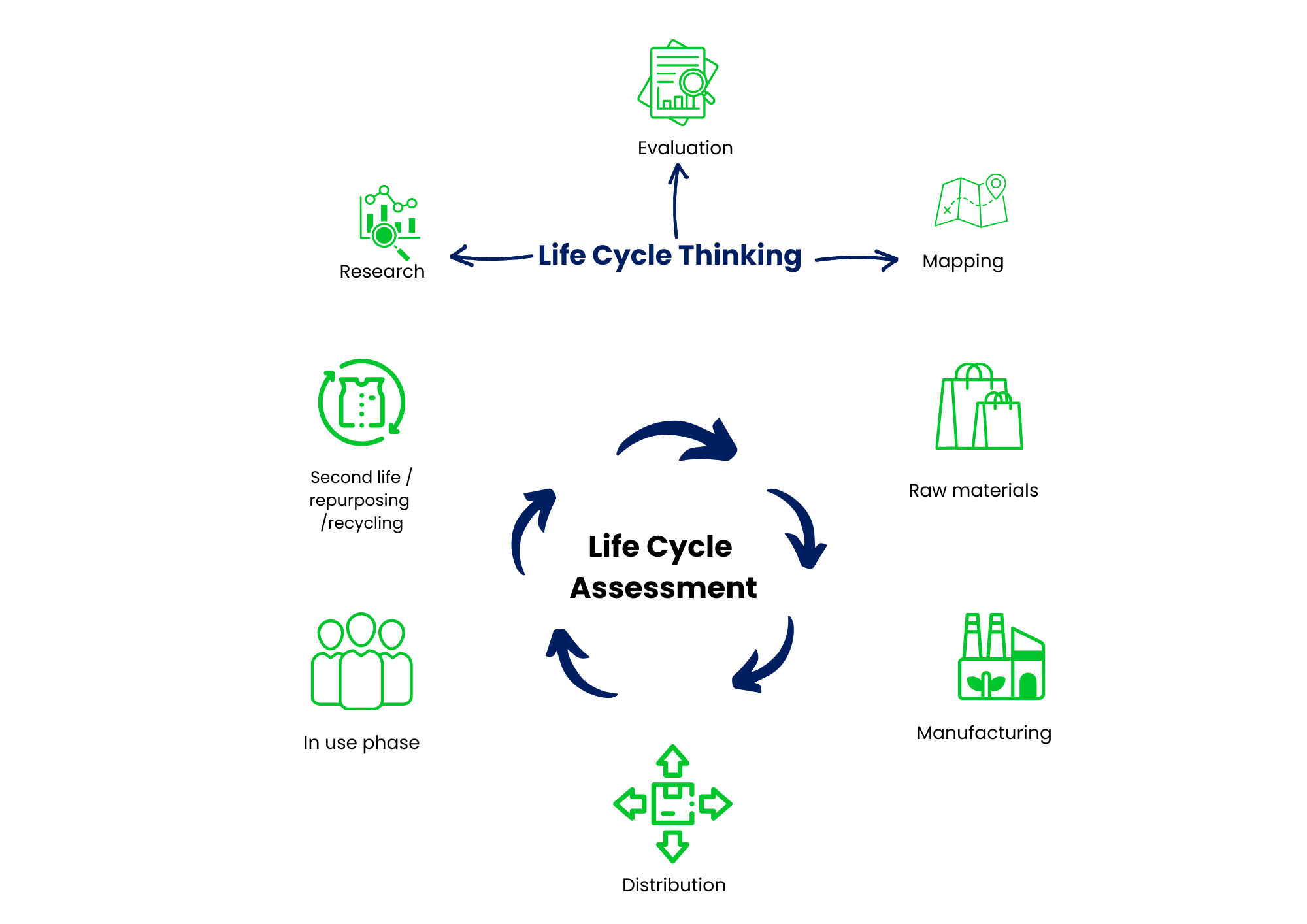
This is where Life Cycle Thinking becomes a transformative and holistic approach, evaluating an event or a product throughout its entire life cycle, considering designing products for circularity, recycling infrastructure at events, and ensuring venues are designed and built for longevity.

Picture Credit: Gonzalo Facello
What is Life Cycle Thinking?
Life Cycle Thinking is a holistic way of understanding the impacts of a product, service, or activity across its entire life span. Instead of focusing on a single stage or issue, it considers environmental, social, and economic effects together, helping decision-makers avoid shifting problems from one phase to another. In practice, life cycle thinking supports more sustainable choices by revealing where the biggest impacts occur and where improvements can make the greatest difference.
What Is a Life Cycle Assessment?
A Life Cycle Assessment is a standardised, scientific method used to measure and quantify the environmental impacts of a product, service, or system throughout its full life cycle, from raw material extraction and manufacturing to use and end-of-life. It includes carbon emissions, water consumption, resource depletion, energy use, waste generation, and impacts on human health and ecosystems. For sports organisations, this means understanding the full impact of merchandise, fan travel, and digital services.
Unlike single metric tools, LCAs help organisations and suppliers avoid burden shifting. This occurs when an initiative reduces impact in one area but unintentionally increases it elsewhere (e.g., reducing operational emissions but increasing resource use in manufacturing).
The International Organisation for Standardisation (ISO) sets out four phases of a LCA: goal and scope definition, inventory analysis, impact assessment, and interpretation of results to inform decision-making.
Case Study: Evaluating the impacts of batteries in Motorsport
Enovation Consulting has worked with motorsport battery manufacturers to ensure that environmental impacts of these products are fully understood and mitigated, carry out a full life cycle assessment.
Similarly, the S1-X racing scooter used in the eSkootr Championship has been developed following a full LCA carried out by Enovation Consulting. Life Cycle Thinking was incorporated from the early design phase: the e-scooter featured natural flax fibre bodywork and natural tyres.
Why do Life Cycle Thinking (LCT) and Life Cycle Assessments (LCAs) Matter for the Sports Industry?
LCT identifies high-impact hotspots: Life Cycle Thinking reveals where environmental and social impacts actually occur. For example, fan travel or merchandise production may far outweigh venue emissions.
LCT supports regulatory and voluntary frameworks: Sports organisations increasingly participate in initiatives such as the UNFCCC Sports for Climate Action Framework, which encourage robust emissions reduction strategies.
LCT differentiates leaders in a competitive landscape: Partners, sponsors, and rights holders increasingly value organisations that demonstrate genuine climate leadership supported by credible analysis.
LCAs enable credible sustainability reporting: With increasing scrutiny from fans, media, and governing bodies, LCAs provide transparent, science-based evidence to support sustainability claims, quantifying environmental impact and informing alternative material or manufacturing processes of products.
LCAs guide more circular decision-making: LCAs provide the evidence needed to identify where materials, energy, and value are being lost in a product’s lifecycle, helping organisations prioritise actions that keep resources in use longer, such as designing for durability, enabling reuse, choosing lower-impact or recycled materials, and closing loops through improved recovery and end-of-life pathways.
Case Study: Life Cycle Thinking at Silverstone
In 2022, Enovation Consulting supported Silverstone in becoming the first motor racing venue to join the UNFCCC Sports for Climate Action programme, signalling a major step forward for circular thinking in motorsport. As part of its commitment, Silverstone has been working collaboratively with the global sporting community to identify and implement effective sustainability solutions.
Enovation Consulting adopted a Life Cycle Thinking approach in 2023 to identify Silverstone’s environmental and social hotspots, including biodiversity impacts quantified through data analysis. This evidence base supported the development of an operational strategy designed to prioritise actions with the greatest impact.
While the public focus is often on visible initiatives such as onsite renewable energy or waste management, behind the scenes, Silverstone has increasingly explored Life Cycle Thinking to better understand where environmental impacts truly originate. The majority of a sports venue’s footprint often sits in Scope 3 categories, including supply chains, travel emissions, construction materials, merchandise, and food services.
How can Enovation Consulting support your sports organisation with Life Cycle Thinking, Life Cycle Assessment, and Circular Economy approaches?
If your organisation is new to Life Cycle Thinking, the best starting point is to identify the events or products you wish to assess. You will need to consider the availability of data, the data collection processes required, opportunities for alignment with existing sustainability frameworks, and areas where Life Cycle Thinking could influence strategy (e.g., procurement, events, materials, biodiversity). Working with experienced Life Cycle Thinking practitioners ensures that results are robust and tailored to real-world operational needs. When products are involved, a Life Cycle Assessment also ensures that scientifically proven data, aligned with the ISO framework, informs circular design thinking.
Enovation Consulting provides a holistic approach to guide sports organisations through the process of a Life Cycle Assessment.
Leveraging the power of data, we help our clients to understand their environmental and social impacts, identifying opportunities to reduce emissions. Our Sustainability Team provides Life Cycle Assessments, identifying hot spots and reduction strategies.
Get in touch to speak to our team of experts, who will be happy to support you through the process.