
How Climate Change is Reshaping Winter Sports

Susanna Sieff (Image Courtesy: Ski Industry Climate Summit via FIS)
Climate change is threatening the very essence of winter sports. Declining snow cover and increasingly erratic seasons mean the snowsports industry faces an existential challenge. Yet despite the outlook, many resorts, federations, events, and manufacturers are taking meaningful action. January’s Ski Industry Climate Summit in Bolzano, Italy, shed light on this momentum.
Enovation Consulting spoke with Susanna Sieff, Sustainability Director at the International Ski and Snowboard Federation (FIS) about her work and what gives her hope for the future. With a long career in sustainability at major sporting events, Sieff has built FIS’ sustainability programme from the ground up.
A Changing Winter Landscape
The impacts of climate change on winter sports are already profound. Days with snowfall have decreased significantly, and resorts below 1200m will soon become entirely dependent on artificial snow to operate. Research shows that by 2050, only 10 of the 21 former Winter Olympic host cities may remain climatically reliable. Indeed, the International Olympic Committee (IOC) had to delay the 2030 Winter Olympic host decisions due to climate concerns.
Athletes at all levels are suffering. Many acknowledge the tension between the impact of travelling and their desire to protect their sport, yet they also recognise the unique platform they have to advocate for change. FIS are developing “a guide for athletes, because sometimes they really need some more information and guidance on how to communicate and deal with specific topics”, Sieff noted.
In a landmark collaboration, FIS and the World Meteorological Organisation are also producing practical tools, including a forthcoming technical guide to help event organisers and resorts apply climate data to operational decisions.

Climate Justice in Winter Sport
As with many aspects of the climate crisis, its effects are felt disproportionately by those with fewer economic resources. Lower-altitude, community-based resorts are the most vulnerable; many lack the finances for snowmaking or adaptation measures and may be forced to shorten their seasons or close entirely, undermining local economies built around winter tourism.
Grassroots snowsport faces similar pressures, with smaller clubs and events often lacking the resources to implement sustainability initiatives. Younger athletes who rely on local assets to train may not be able to travel or use indoor facilities, deepening inequalities in athlete development.
Sieff highlighted that adaptation will look different across regions. For many low-altitude resorts, she believes that shifting toward alternative winter or outdoor activities may be more realistic than investing heavily in snowmaking. “Instead of putting a lot of money into something that in the future won’t be there, [we should focus] on finding a different solution to keeping the local communities alive”, she said.
Image Courtesy: FIS
Industry Leadership and Innovation
The winter sports community must both reduce its climate impact and help drive broader societal change.
Sieff pointed to several promising initiatives across the sector. SkiStar, for example, has created a coalition of resorts committed to sharing best practices and accelerating change. On the event side, the Nordic Championships in Trondheim achieved a 96% emissions reduction from heating by switching from diesel generators to bio-based pellets and HVO, cutting the event’s overall footprint by around 30%. Trondheim also removed spectator parking entirely and instead provided electric buses, demonstrating the impact of targeted decisions.
FIS supports these innovations through a pilot-project approach designed to test, scale, and adapt initiatives across disciplines and regions. The Ski Industry Climate Summit reinforced the need for collaboration across the entire industry: “It’s an ecosystem, and we have to work together to be more sustainable”, said Sieff.
Future progress will depend on promoting responsible mountain behaviour, developing circular sportswear and equipment, improving local sourcing, investing in adaptation technologies, and expanding electric mobility. Sieff also stressed the importance of maintaining focus on sport’s social value, particularly its health benefits, while addressing environmental challenges.
Athletes also have a vital role to play. Their advocacy for low-emission events, streamlining training and competition schedules, and broader climate action can shape environmental policy beyond winter sports.
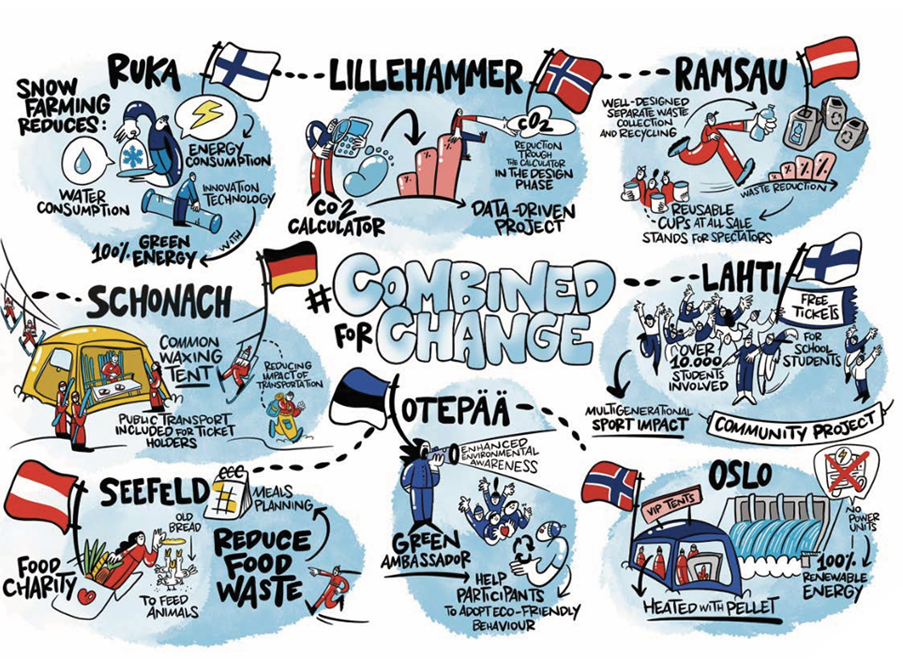
Nordic World Cup Combined for Change Sustainability Tour (Image Courtesy: FIS)
Looking Ahead
Despite the scale of the challenge, Sieff remains optimistic: “we have a lot of young people inside the ecosystem, very talented and very keen to take sustainability into consideration when it comes to deciding how to organise an event, how to run a ski resort, and how to produce a new pair of skis”. The pace may never feel fast enough given the realities of climate change, yet she believes this collective momentum is reason enough to stay hopeful about the future of winter sports.