
How Formula 1 Is Driving Sustainability On and Off the Track
Image credit: Unsplash - Pat Whelen
Net Zero 2030: From Commitment to Operational Change
In 2019, Formula 1 released its first-ever sustainability strategy, an ambitious plan to achieve Net Zero by 2030. Today, F1’s sustainability evolution continues to accelerate, driven by unified action across teams, promoters, circuits, and the FIA.
The 2025 F1 Sustainability Update reports a 26% reduction in the sport’s carbon footprint since 2018: notable progress despite the calendar expansion from 21 to 24 races and record global attendance. This reduction reflects improvements related to logistics efficiency, increased biofuel use, expanded renewable energy generation, remote broadcast operations, sustainable aviation fuel (SAF) investments, and factory-level carbon management practices.
Team Achievements: Emissions Reduction, Renewable Energy & Circularity
F1 teams have been driving decarbonisation within their operations and have contributed to the overall reduction in the sport’s carbon footprint, a considerable achievement in less than a decade.
Among teams making the most progress is Mercedes AMG PETRONAS F1 Team. In 2024, Mercedes prioritised emissions reduction strategies on logistics, including widespread HVO100 adoption for European logistics, the purchase of SAF certificates, and the electrification of pool vehicles. Together, these measures delivered a reduction of 35% in Race Team Control emissions compared with 2022. Beyond logistics, the team also achieved 100% renewable electricity use at their Brackley headquarters and installed 550 sub-meters, enabling real-time monitoring and energy efficiencies of up to 30% baseload reduction in pilot areas.
McLaren Racing has taken a similar approach, prioritising logistics decarbonisation. The team achieved a 48% emissions reduction in European road freight via HVO fuels and became one of the largest buyers of SAF in global sport, funding over 1 million gallons for aviation decarbonisation. Away from logistics, McLaren’s leadership in materials innovation remains notable: the team introduced recycled carbon fibre and bio-composite materials, while publishing the F1 Constructors’ Circularity Handbook in 2025 alongside F1 and Deloitte, which provides robust and consistent measurement in circularity practices across the sport.
Aston Martin Aramco continued to embed its sustainability strategy through advancements in waste-to-energy solutions, solar power generation producing 1.3 GWh, and circularity pilots, including carbon fibre reuse.
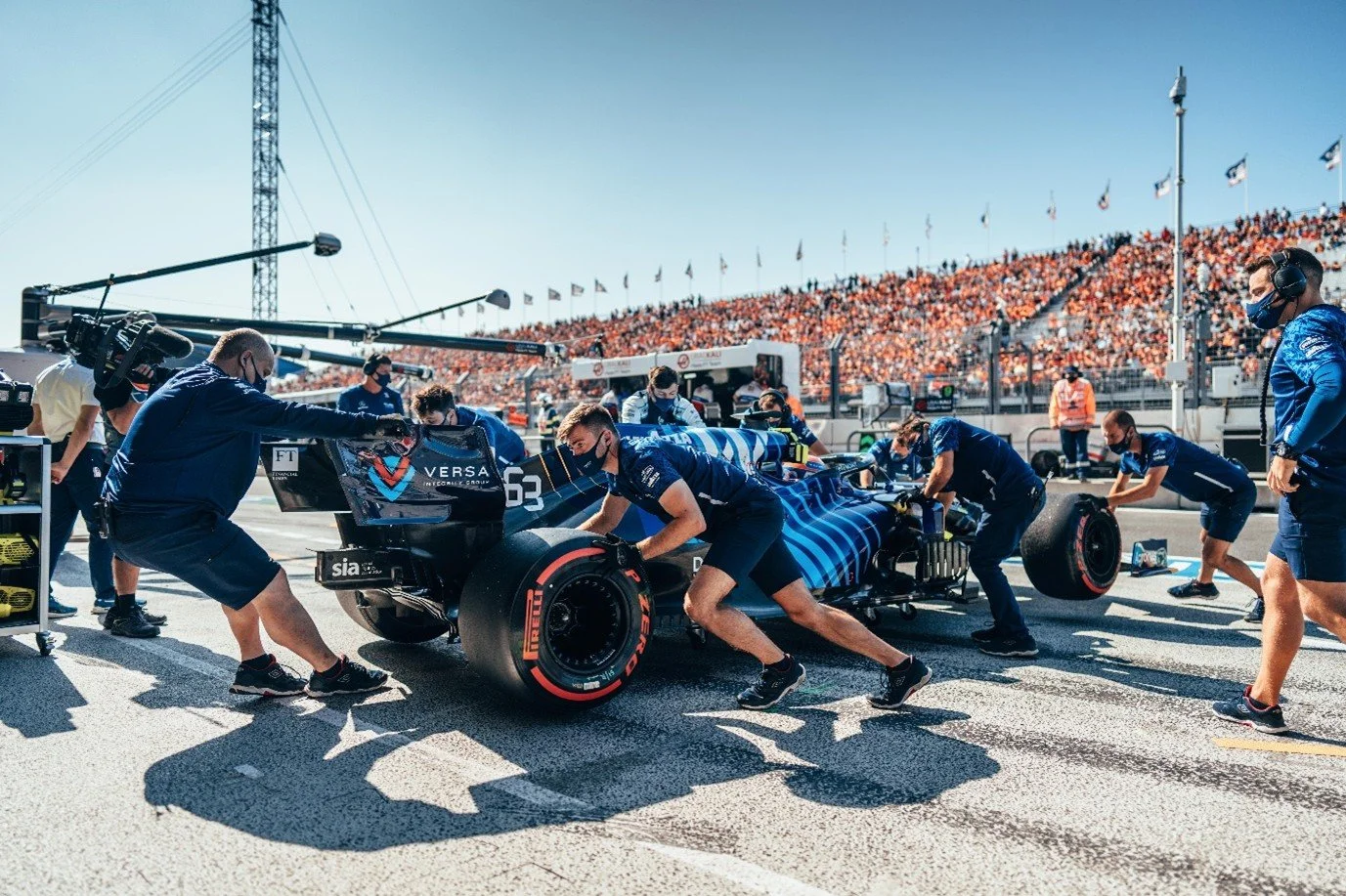
Image credit: Williams Racing F1
Williams Racing also maintained progress, supported by LED lighting upgrades, renewable electricity across their operations, and waste-to-energy initiatives saving over 100,000 kg CO₂e.
Across the rest of the grid, Red Bull Racing, Ferrari, Alpine, Visa Cash App Racing Bulls, Haas, and Kick Sauber collectively contributed to a 59% reduction in factory emissions and a 25% reduction in travel emissions. These improvements were largely driven by increased participation in renewable energy programmes and the purchasing of SAF certificates for their race travel operations. Taken together, these reductions reflect collective action that spans the entire grid, not only from teams most active in sustainability reporting.
Biodiversity and Environmental Stewardship
When it comes to biodiversity, office environments are not usually havens for flora and fauna. However, as Formula 1 teams invest in campus-style headquarters, they are gaining new opportunities to champion environmental stewardship both on their land and within local communities.
Biodiversity was a core consideration during the construction of Aston Martin’s new Technology Campus. The project, by promoting habitat creation, green corridors, and targeted ecological enhancements designed to support long-term biodiversity improvement, delivered a 122% biodiversity net gain – among the highest reported in motorsport.
In Grove, Williams is actively involved in local nature restoration at Letcombe Brook, where the team and their partners have undertaken large-scale habitat improvements and species protection initiatives. Their extensive biodiversity work includes invasive species removal, stream health improvement, and long-term conservation work, supported by thousands of volunteer hours.
Mercedes has also embedded biodiversity within its Brackley campus redevelopment. In 2024, ecological surveys identified a population of English common lizards on site; the construction was paused , and all 11 lizards were safely relocated to a newly created habitat featuring wildflower meadows, log piles, and nesting zones. This rewilded area now forms part of a wider biodiversity enhancement plan linked to the factory redevelopment.
At the McLaren Technology Centre, biodiversity-friendly practices include wetland habitat conservation and measures to support pollinators. The team also participates in external biodiversity initiatives, including coral reef restoration projects in partnership with the Great Barrier Reef Foundation.
Formula 1 Management: Leading by Example
Formula 1 continues to adapt its operations in line with its 2030 Net Zero strategy. The 2025 Sustainability Update highlights increased remote broadcast operations, reducing travel for approximately 140 staff per race weekend, alongside increased use of sea freight and redesigned freight containers that enable more efficient aircraft use. Together, these measures have contributed to a reduction of around 9,000 tCO₂e since 2018.
Further progress has been made through the use of DHL’s biofuel-powered logistics for Formula One Management equipment, delivering an 83% emissions reduction during the 2024 European season. Calendar optimisation achievements, including the grouping of Asian and Middle Eastern races, have also played a role in reducing freight-related emissions.
Looking ahead, the sport is preparing for Advanced Sustainable Fuel adoption under the 2026 car regulations, representing a major transition with road-relevant applications. As Formula 1 has historically served as a test bed for road-relevant technologies, this transition represents an opportunity to influence broader transport decarbonisation, while reinforcing environmental stewardship across both operations and fan engagement.